

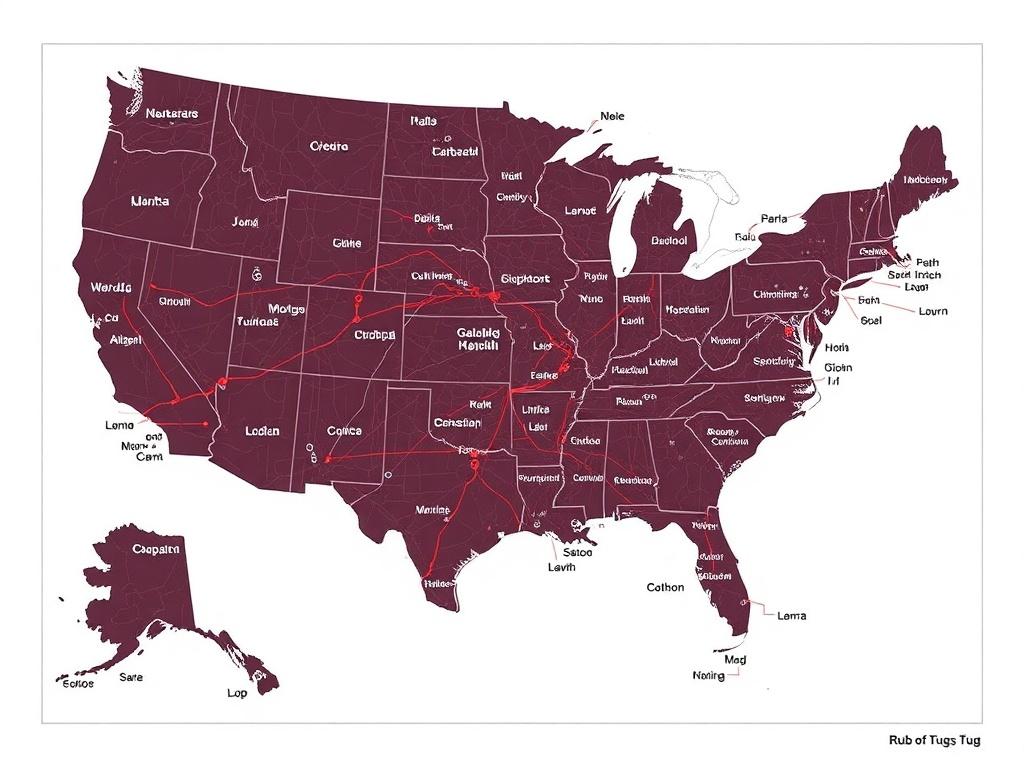
The phrase “rub and tug map” conjures a tidy image — a digital map full of pins pointing to massage parlors — but the reality behind that phrase is messier, darker, and worth unpacking. In some circles it’s shorthand for directories or threads that list businesses offering sexual services under the cover of licit massage. In others it’s a sociological shorthand for the networks, markets, and legal gaps that allow exploitation to persist. Whatever label you prefer, the subject sits at the intersection of public health, law enforcement, technology, and community ethics. This article walks through what people usually mean by the phrase, how such maps appear (and why that matters), who gets hurt, and how journalists, researchers, and local leaders can address the problem without amplifying harm.
What people mean by a “rub and tug map”
At its simplest, a “rub and tug map” is any compiled representation — a list, map, or database — that marks locations believed to offer sexual services disguised as massage or spa businesses. Those compilations can take many forms: an old forum post, a hidden Telegram channel, a public spreadsheet, or even a law enforcement case file. The name itself is slangy and carries stigma; behind it are real businesses, workers, and sometimes victims, all operating under different legal and social pressures.
It helps to separate three broad things that people might be talking about: (1) informal crowd-sourced directories assembled by patrons or commentators, (2) hidden or illicit directories designed to facilitate transactions, and (3) official maps or datasets compiled by governments or researchers for enforcement and public health. Each has different origins, audiences, and consequences.
Why maps matter
Maps are powerful because they turn diffuse knowledge into a format that’s easy to act on. A pin on a map suggests precision, legitimacy, and immediacy. For a researcher studying patterns of exploitation or a city health official tracking sex-industry clusters, aggregated location data can reveal trends and help allocate resources. For a patron or criminal actor, the same map can facilitate harmful behavior. For victims, a public map may increase exposure, stigmatize neighborhoods, and invite predatory attention.
How these maps are made — and the trade-offs involved
There’s no single recipe for creating a “rub and tug map.” Methods vary depending on motive, skill, and access to data. Below is a practical comparison of common approaches and their typical benefits and harms.
| Map Type | Common Data Sources | Typical Uses | Risks and Harms |
|---|---|---|---|
| Crowdsourced directories | User posts, reviews, social media, forums | Quick sharing among patrons, rumor-tracking | High inaccuracy, promotes illegal activity, harms workers |
| Hidden illicit platforms | Invitation-only groups, encrypted chats, private ads | Transaction facilitation, protection from public scrutiny | Criminal coordination, exploitation, human trafficking risks |
| Official/academic datasets | Licensing records, inspections, police reports, qualitative interviews | Policy, enforcement, public health planning | Privacy concerns, risk of re-identifying victims if mishandled |
| Automated scraping and GIS | Business listings, reviews, geocoded addresses | Large-scale pattern analysis, hotspot detection | False positives, ethical concerns about consent and surveillance |
Accuracy and the myth of objectivity
A notable paradox: maps feel objective, but the data feeding them rarely is. Business names change, addresses shift, false reports circulate, and malicious actors deliberately seed misinformation. That instability matters. An apparently authoritative pin on a public map can lead to harassment, bad policing, or economic harm for legitimate workers. Responsible work with these datasets begins with humility about accuracy and an insistence on safeguards for privacy.
Legal and ethical implications
Different stakeholders see different legal levers. Law enforcement may view mapping as a tool to target illicit activity; public health authorities may see it as a way to direct outreach and services; civil liberties groups worry about surveillance and the criminalization of marginalized people. The legal framework also changes by jurisdiction — some cities have stringent licensing and inspection regimes for massage businesses, while others have laxer systems that create gaps exploited by bad actors.
Ethically, there are three running concerns: consent, privacy, and harm amplification. Collecting and publishing location data without informed consent risks exposing vulnerable individuals. Republishing user-generated accusations without verification can destroy lives. Even well-intentioned visualizations can be weaponized by those seeking to exploit or shame. That’s why best practice demands careful risk assessment before building or sharing any map involving potentially criminalized activities.
Impacts on victims and communities
From a social perspective, the appearance of these maps can stigmatize entire neighborhoods and sectors. Workers who are independent and consensual can be swept into crackdowns meant for exploitative operations. Trafficked individuals may become further isolated if enforcement responds with raids rather than support. Conversely, in some cases, data-driven interventions have helped identify trafficking networks and reunite victims with services — but those outcomes are contingent on careful, multi-disciplinary approaches.
Technology’s double-edged role
GIS tools, web scraping, and machine learning make it possible to spot patterns at scale. Automated scraping of public ads, for example, can help researchers estimate trends across time and space without engaging in street-level surveillance. Yet those same tools can power online directories used by buyers and traffickers. Platforms that host user reviews or classified ads face complex decisions about moderation, liability, and user safety.
Another technical concern is re-identification. Even datasets stripped of names can often be triangulated to reveal identities if they contain detailed timestamps or geocoordinates. That risk is particularly acute when dealing with small clusters where a single address might point to a private home or a small business with a handful of workers.
Constructive approaches: harm reduction, policy, and research ethics
Tackling the problems implied by “rub-and-tug maps” requires mixed strategies rather than single fixes. Below are practical steps for different actors that aim to reduce harm while improving accountability.
- For journalists and researchers: prioritize informed consent, anonymize data rigorously, and partner with service providers to validate findings before publication.
- For platform operators: enforce clear prohibitions on ads facilitating sexual services, invest in proactive moderation, and provide reporting channels for suspicious content.
- For policymakers: balance enforcement with funding for victim services, labor protections, and licensing transparency that doesn’t put workers at risk.
- For community groups: focus on outreach and safe reporting mechanisms rather than public shaming; build relationships with health providers and law enforcement that treat victims as people in need of services.
- For law enforcement: couple data-driven investigations with trauma-informed response teams and avoid draconian sweeps that further victimize those in need.
Ethical checklist for anyone working with related data
- Assess: Will publishing this location data increase risk for individuals? If yes, do not publish.
- Verify: Corroborate allegations with multiple sources before making them public.
- Protect: Remove identifiers and aggregate at a scale that prevents re-identification.
- Collaborate: Work with NGOs and victim-service organizations to shape outcomes.
- Document: Keep a clear ethical rationale and record of decisions for accountability.
Resources and where to get help
When discussing sensitive topics, it’s important to point readers toward support systems rather than leaving them with only analysis. If you suspect someone is being exploited, local hotlines, trusted NGOs, and law enforcement (where appropriate and safe) can help. Contact information varies by country, but many nations maintain national human trafficking hotlines and social service directories. Community legal clinics and labor rights organizations can also advise those working in the massage industry about safety and rights.
Researchers and reporters should also consult established ethics guidance from institutional review boards, journalism ethics codes, and organizations that specialize in studying trafficking and sex work. Those bodies offer frameworks for balancing public interest with individual safety.
Conclusion
A “rub-and-tug map” is more than a string of pins: it’s an entry point into complex questions about legality, labor, technology, and human dignity. Maps can illuminate patterns and direct resources, but they can also amplify harm when built or shared without care. The responsible path forward emphasizes verification over sensationalism, privacy over click-driven exposure, and services over punitive responses. If we want fewer people harmed and more problems solved, the conversation must move from lurid curiosity to deliberate strategies that protect victims, support legitimate workers, and use data as a tool for justice rather than a mechanism for exploitation.